The Age of the Chicken: A Legacy Written in Bones
This post reveals how industrial chicken farming is rewriting our planet’s geological record, marking the dawn of the "Gallocene"—an era defined by the mass fossilization of chicken bones.
Image: weanimals.org
In a distant future—long after our civilization has faded—scientists might sift through layers of Earth and make a startling discovery: trillions upon trillions of chicken bones, fossilized in landfills, their altered shapes and unnatural densities forever etched into the planet’s geological record. These bones—remnants of the chickens bred, used, and discarded by the egg and meat industries—will tell a story of human dominance, consumption, and neglect.
Some scholars have already named this era the “Poultryocene” or “Gallocene”—the “Age of the Chicken”. Not because chickens have thrived, but because they’ve been bred in such astronomical numbers that they have literally reshaped Earth’s biosphere. At any given moment, there are over 23 billion chickens on Earth, far surpassing the population of any other land animal.
A Bird We Barely Know
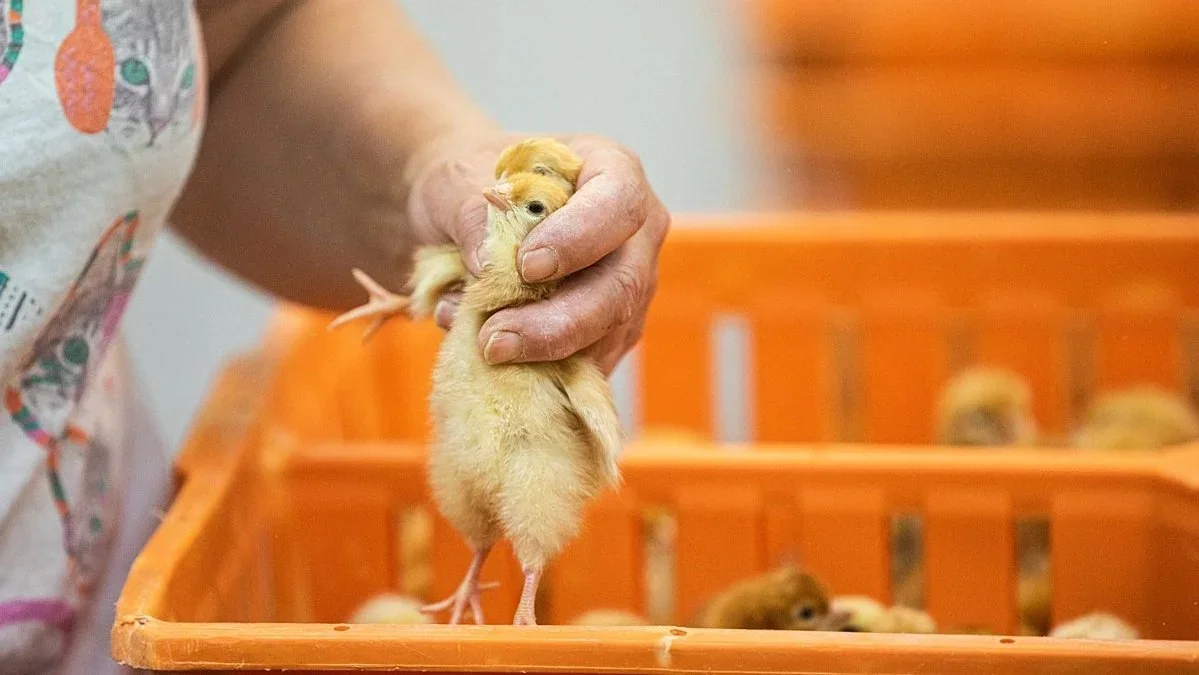
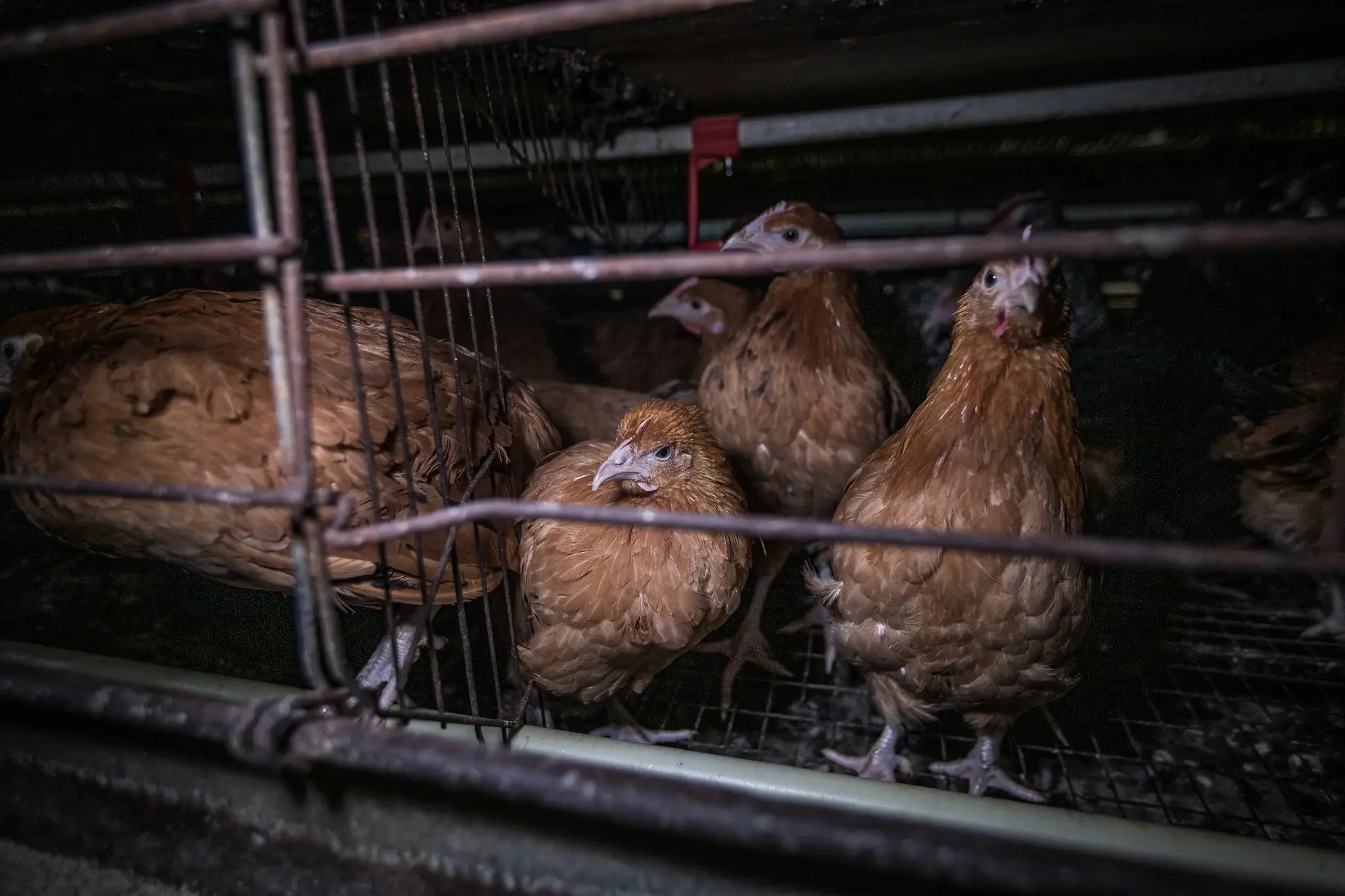
Ironically, while we live in an apparent “Age of the Chicken,” most of us rarely see living chickens at all. In supermarkets, we find sanitized packages of wings and drumsticks. On egg cartons, we see idyllic illustrations of hens roaming free. The reality is drastically different: in the meat industry, chickens have been bred to grow so fast they suffer crippling health problems, and in the egg industry, hens are pushed to ovulate incessantly at great detriment to their health.
Modern “broiler chickens” are engineered to grow three times faster and pack on five times the biomass compared to chickens of the early 20th century. This extreme breeding is all about profit: more white breast meat in less time. Typically, these birds are slaughtered at just five to seven weeks old, whereas a wild fowl might live up to eleven years. Because their hearts and lungs can’t keep pace with such explosive growth, many chickens experience heart failure, respiratory issues, and severe leg pain if allowed to live beyond the typical slaughter age. Even in sanctuaries that rescue them, so-called “broilers” often struggle with chronic health issues and rarely reach old age.
Meanwhile, “layer chickens” have been bred to lay about 500 eggs a year, dwarfing the mere 10 to 15 that their wild ancestors once laid—only in spring. Each ovulation can be fraught with pain or life-threatening complications. Conditions like egg yolk peritonitis (when egg material leaks into the body cavity), cloacal prolapse, and ovarian cancers are tragically common. What nature intended as a cyclical, occasional process has become a daily production line, inevitably ending in chronic pain or premature death.
Fossilized Footprints of Suffering
All these trillions of chickens—confined, bred to extremes, and slaughtered—will leave their mark on Earth’s geological record. Their bones, piled in landfills, will serve as a stark signal that something colossal and troubling took place. Future scientists could easily identify a massive surge in chicken fossils dating from the mid-20th century onward, silent witnesses to industrial-scale breeding and hidden cruelty. Unlike dinosaur remains—whose disappearance marked natural catastrophes—these modern chicken fossils would reveal a disaster of our own making: one born of human exploitation. Their bones would testify to how we altered their DNA, cramped them into factory farms, and discarded them in unfathomable numbers.
Despite the overwhelming presence of chickens in our food system, few consider them beyond their role as commodities. We call this the “Age of the Chicken” not because we honor or celebrate these birds, but because in death they overwhelm our culture—stripped, sliced, and served before we ever truly acknowledge their lives.
Chickens are remarkable creatures, however, —curious, intelligent, and socially complex. They forge deep connections, navigate intricate social hierarchies, and revel in pleasures like dust bathing and nesting. They recognize one another’s faces, communicate with genuine empathy, and are devoted mothers who bond with their chicks both before and after hatching. Yet in the industrial egg and meat sectors, these natural behaviors are systematically suppressed. Confined to overcrowded sheds, denied meaningful interactions, and forced into unnatural breeding and egg-laying cycles, chickens are reduced to mere cogs in the relentless machinery of food production. The industry strips them of their inherent dignity, turning vibrant, sentient beings into products with a singular purpose—profit.
If we genuinely live in the “Age of the Chicken,” then we owe it to these creatures to see them as more than commodities. Their lives are defined by intelligence, empathy, and social bonds—not merely by fast-growing muscles or high egg yields. Every purchase of chicken or eggs fuels an industry that prizes volume and profit at the expense of animal well-being.
Choosing Compassion
Every choice we make has consequences. One of the simplest yet most impactful ways to change the fate of chickens is to stop consuming them. This so-called “Poultryocene” doesn’t have to be a story of suffering; it can be a turning point, if we decide to honor life rather than exploit it.
Please leave eggs off your plate.
By choosing compassion, we can rewrite the legacy that future geologists—and future generations—will unearth in Earth’s layers. Let’s make sure that when they find these bones, they also find evidence of a turning tide toward empathy and respect.
Sources & Further Reading
Article Sources:
Bennett, Carys, Richard Thomas, Mark Williams, Jan Zalasiewicz, et al. “The broiler chicken as a signal of a human reconfigured biosphere,” Royal Society Open Science, 12 December 2018.
Narayanan, Yamini. “An Ecofeminist Politics of Chicken Ovulation: A Socio-Capitalist Model of Ability as Farmed Animal Impairment,” Hypatia, vol. 39, 2024.
Further Reading:
The Creation of the Modern Hen: Hen History
The Suffering of the Hens in the Egg Industry: Life of a Hen
How to Replace Eggs: Recipes and Resources
Ready to Go Vegan? Vegan Bootcamp
This post was informed by the valuable input of Chloë Taylor, whose academic expertise and research played a key role in shaping the article.
Gerri's Story
“Saving Gerri was, hands down, the most humbling and inspiring thing I’ve ever done in my life”. - Georgia Rae Laidlaw Brown
Gerri on her day of rescue.
Saving Gerri was, hands down, the most humbling and inspiring thing I’ve ever done in my life.
And even as a long-term vegetarian (now vegan activist), I had no idea how intelligent and kind natured chickens could be.
The day we rescued Gerri was the day she was destined for the slaughterhouse. Her days as a commercial laying hen were over and the next step in the process was for her “to be finished” - an industry term that means: killed and sold to the public as meat!
Luckily for Gerri, and the other 200+ chickens with her that day, they were given a second chance and were re-homed.
Gerri’s life was brutal from the very beginning, and even years later I have trouble processing what had intentionally been done to her. The photo shown here is of Gerri on the day she was rescued. Until this time, she had never seen daylight, her wings and beak had been clipped and she had been laying eggs at the unnatural rate of approx. 340 eggs a year in caged isolation. This is a sad fact-of-life for chickens that is a well-kept secret from consumers.
Much of the language used to describe how animals are treated in factory farms is chosen to mislead the public and paint a picture that makes the whole process acceptable. Make no mistake, the words and images are carefully chosen. Words like, “welfare” are used to mask what is actually just varying degrees of deprivation and cruelty. The images of happy, healthy chickens we often see on egg boxes are a misrepresentation of the conditions in which chickens live. And this include eggs sold as “free-range” and “organic” which may be the most misleading of all.
But lately attitudes have been shifting. Thanks to many main-stream documentaries and under-cover videos on social media and elsewhere, more and more people are beginning to see what is going on. Every day the conditions that all animals endure on factory farms is being exposed and talked about and the truth is getting harder to hide.
Gerri gettin’ in to the cream cheeze!
So… a little more about Gerri. She is as hilarious as she is bold and brave. From her very first day with us, she has taken everything in stride. (Here she is, covered in vegan cream cheese after sharing a bagel with me!) Just look at her little face!
When we first rescued Gerri she was not going to be a house chicken. She is one today because that is what she wanted. Daily she would peck at our door asking to come inside and before we knew it, she was spending most of her day in the house with us. She does venture outside to sleep in her house, or at the bottom of the garden, and for the occasional stroll around the property.
Like many animals who are given the chance to live in a loving and nurturing environment, Gerri knows her name and she will come running to you when called. She also likes to hang out with her cat and dog siblings and enjoys napping in the dog bed.
Gerri and her canine siblings.
Also, like everyone, Gerri is an individual with personal likes and dislikes and that extends to her food preferences. Her favourite food is mashed potato, but her preferences can change depending on her mood. Of course, she has her organic corn and pellets, but she is also partial to hummus, tomatoes, blueberries, cashew nuts, jackfruit, but not yellow peppers… she can’t stand them and will spit them out!
Gerri is my daughter, and my best friend, and I really do love her very much! She is a huge part of our family and loved completely and equally alongside the other animals (and humans!) She’s very expressive, funny and will fuss around you for attention just like the dogs do.
Gerri scoping out her sleeping arrangements.
In fact, I haven’t met anyone that hasn’t been blown away with how clever and sweet natured Gerri is – and I truly believe that all chickens have this potential, if they are only given the chance.
Gerri inspires me every day and I’m honoured to share a little more about her life and her story as well as shedding a little light on the commercial egg industry that exploits these beautiful animals.
I would encourage everyone to consider giving up eggs and going vegan. And, if your situation is right for it, rescuing an ex-commercial laying hen. You can also make a difference by donating to the various chicken rescue organisations. As individuals we can each a make huge difference.
As for Gerri, her confidence and character grows daily and I hope that her story inspires people to see what wonderful friends and family members chickens can be!
For more images and videos etc. head to: Georgia Rae Laidlaw Brown.
To learn about the true lives of the billions of hens condemned to lay in commercial, egg farms around the globe, please visit: Egg-Truth
Georgia Rae Laidlaw Brown has been vegan for 3 years and is a trained Broadcast Journalist and PR Professional. She is vegan for the animals, but also for the environment, her health and future generations.
Hens To Slaughter
On September 19th, 2018, I attended a vigil to bear witness to egg-laying hens brought to slaughter at Maple Lodge Farms in a suburb of Toronto, Canada (the 4th largest city in North America).
Prior to this I decided to take a look at their website for research purposes. Immediately upon landing on their homepage, visitors are met with imagery intentionally designed to invoke the bucolic days and by-gone era of the “family farm”. This is an often used marketing strategy to assuage concerns consumers might have as it relates to animal welfare and environmental issues in animal agriculture.
Maple Lodge Farm’s home page.
In reality, Maple Lodge Farms (“MLF”) is one of the largest processing facilities in North America. It is, by all definitions, a “factory farm” facility. MLF slaughters approximately 500,000 birds a day - that is 182,000,000 chickens and egg-laying hens per year. Their products are sold across Canada and they are a leading processor of Halal chicken (which means the birds cannot be stunned before their throats are cut).
False Advertising
MLF also promotes in virtually all of it’s advertising that their products are “Proudly Raised On Local Ontario Family Farms”. But is this true? No - at least not on the night I was there. Every truck that arrived between 6pm and 9pm came from Pennsylvania and Ohio. Members of Brampton Chicken Save, who attend these vigils weekly, have indicated they have also seen trucks routinely come from New York State, as well.
So why are American egg farms sending their spent hens to Canada? I can only offer speculation. On the face of it, it would seem to be more economically viable to send spent hens to a facility stateside. Spent hens are slaughtered for products like dog food or low-grade, processed chicken filler. It even appears that, “the meat industry has . . . . convinced the US government to dump this meat which should only be consumed by non-humans or be turned into pet food or compost, into the National School Lunch Program”. In other words, the U.S. government is feeding slaughtered hens to children while subsidizing the industry at taxpayers’ expense. (Side note: Given that hens have the highest prevalence of spontaneously occurring ovarian cancer of any species in the world, it is very conceivable that American children are actually eating food processed from birds afflicted with cancer.)
Above gallery: photos of truck license plates showing where the hens arrived from.
So again, why are American hens coming to Canada for processing? It may simply be because the supply exceeds the demand for hens produced from the U.S. egg industry despite a percentage destined for school lunch programs. It would seem U.S. egg farms, who cannot find a local processor to take their birds, have two choices: either dispose of spent hens on-site when their laying cycle comes to an end and they are replaced by new layers, or sell them to a foreign market like Canada.
The latter appears to be the case, at least from some farms that reside in border states like Ohio, Pennsylvania and New York where the cost of transport can be kept to a minimum. And this begs another question: What is MLF paying for these birds? Are they paying very little relative to what they would pay Canadian egg farmers? Or are they paying absolutely nothing beyond the cost of transport? This seems more plausible as it would benefit the farms that do not have to invest in maceration or gassing equipment to dispose of their hens. Some of these farms may also be prohibited from dumping or incinerating dead (or near-dead) hens on site due to environmental restrictions. These U.S. egg farms are probably glad MLF are taking them off their hands. And if this is true, then MLF’s margins are probably better than what they enjoy from spent hens arriving from Canadian farms.
Transport
So how do the rules around the transport of egg-laying hens apply when these animals are transported across international borders? In Canada, the CFIA (Canadian Food Inspection Agency) stipulates poultry can be transported for no more than 36 hours without food or water. However, the clock doesn’t start ticking until the trucks cross the Canadian border. If a trip from the Windsor/Detroit or Buffalo/Ft. Erie border takes 3 or 4 hours they are well within the window. But, neither the CFIA, Maple Lodge Farms, nor any other Canadian authority have jurisdiction stateside. How long the hens are on a truck before they reach the Canadian border is anyone’s guess.
So let’s look at what the distance and travel time is direct between a farm in Medina, Ohio to Maple Lodge Farms slaughter facility (see map below). Let’s also assume the truck loaded all the hens from only one farm in Ohio (so no other stops or pickups were made) and there were no delays at the border or as a result of traffic on either side. From Ohio it would take anywhere between 5 to 6 hours. Realistically you could add a one hour delay at the border and anywhere between 1 to 2 hours for traffic snarls and congestion (certainly on the Canadian side where the truck must travel all 400 series highways) as well as at least one pit stop for the driver (add 30 minutes). That equals anywhere between 7.5 to 8.5 hours and 310 miles or 500 kilometres.
Map of route distance and time between Medina, OH and Brampton, Ontario.
And what about Pennsylvania? It would appear to be closer to 8.5 to 9.5 hours with a distance of 370 miles or 600 kilometres. Both of these trips are within the window required by the CFIA. That said, both of these journeys would be further and longer than most trips hens would typically endure from farms located within the densely populated Southern Ontario region. Regardless, and as pointed out previously, this supply of American spent hens is not in keeping with MLF’s advertised pledge to Canadian consumers of “Proudly Raised On Ontario Family Farms”.
It can easily be argued that what Canadians are entitled to and should receive, are assurances that the food they purchase and consume are done so according to the rules and regulations put in place by Canadian-taxpayer-funded agencies whose job is to ensure compliance. No matter how inadequate those rules might be at times. There is no way to ensure that compliance, as it relates to transport, is being adhered to regarding animals coming from the United States. The CFIA has no jurisdiction over egg farms nor over transport companies in the United States. And likewise, the USDA has no jurisdiction over processors in Canada. It is a grey area that really needs some light shined on it.
Map of route distance and time from central Pennsylvania and Brampton, Ontario
The Hens
When the trucks arrived at the gate for MLF, and even before you can see the hens, the smell of urine and feces is pronounced. The hens arrive crammed into very low profile transport crates which are overcrowded. The birds are typically wide-eyed and alert which is understandable given their harrowing journey. Most suffer from extreme feather loss having been confined in tiny cages for up to two years. Some prolapses are visible on some of the birds and some open wounds can be seen - injuries likely due to rough handling when plucked from their battery cages and stuffed into the crates. Time is money and quick loading is the order of the day. I did not see any dead birds on arrival, however, in more extreme weather conditions (especially in the winter) D.O.A.’s are routine.
There is a genuine sadness in my heart when I look at these poor creatures up close. My empathy takes over as I know what awaits them mere minutes away. Much of the world does not look at these poor birds like the beloved companion animals so many of us are familiar with. Nonetheless, I have yet to find or hear a morally consistent argument that can successfully rationalize that they are any different than our beloved dogs and cats.
I feel a bit angry to be honest because I so desperately want to focus on them, to stare into their eyes deeply, to reach out and touch them and give them one brief moment of compassion. Yet, to get the photos I need to share with readers, I almost have to put that aside and concentrate on trying to focus the camera within the two minutes we are allowed to stop the trucks before they disappear behind the gates. I wish I had just a few more minutes. Below is a gallery of some of those photos, not just of the hens but of the facility and the compassionate group of people who continuously come out night after night to bear witness.
Animal Welfare
Maple Lodge Farms’ reputation is not a good one when it comes to animal welfare. In May of 2014, two convictions were registered for offences under the Health of Animals Act. Specifically, MLF was charged by the CFIA for, “ . . . violations (that) involved injury or undue suffering of chickens caused by undue exposure to weather or inadequate ventilation during transportation.” Also, as reported by The Toronto Star, and many other regional and national news organizations in Canada at the time, Maple Lodge Farms “will have to spend at least $1 million over three years to ensure compliance with federal rules after an Ontario judge convicted it of causing undue suffering to the birds.”
However, the monetary penalties incurred by a company the size of MLF is hardly a deterrent. So much so, that less than one year later, Maple Lodge Farms was implicated in yet further animal cruelty (see video below) and while they were on probation from the previous convictions.
It is important to note that spent hens processed in Canada are required to be put through CAS systems (Controlled Atmosphere Stunning) prior to being processed. This renders the birds senseless and/or unconscious prior to being hung upside down on shackles and sent down the line. The stunning requirement is mandated because a hen’s body is so exhausted, depleted of calcium and nutrients that their bones are exceedingly brittle and at risk of breaking if handled while conscious. And this in turn would inflict further pain and suffering for these birds. It also spares workers from experiencing the endless damage they would undoubtedly inflict on these poor creatures if they were live hung.
Conclusion
There is no doubt that these matters as it relates to transport, duration and processing are all very complicated indeed. However, there is one way to make all of this simply disappear - going egg-free. If these animals are not selectively bred, if they are not confined, if they are not transported, and if they are not slaughtered, there is no issue. Each and everyone one of us can undo all the harm these industries inflict on these animals - just don’t buy their products. It truly is up to each and every one of us. There are so many egg-free, delicious alternatives out there. Any doubts about how animals are treated in our food system can be mitigated (or eliminated) by not eating them and/or their eggs or by-products.
I would encourage any curious-minded and reasonably compassionate person, whether you are vegetarian, vegan or not, to come out to a vigil . . . . look the animals in the eyes near their time of death. As Tolstoy once said, “When the suffering of another creature causes you to feel pain, do not submit to the initial desire to flee from the suffering one, but on the contrary, come closer, as close as you can to her who suffers, and try to help her.”
People like the folks from Brampton Chicken Save, are trying to help them. Will you join us? There is no doubt there is a Save Movement near you.