Factory Farm Map
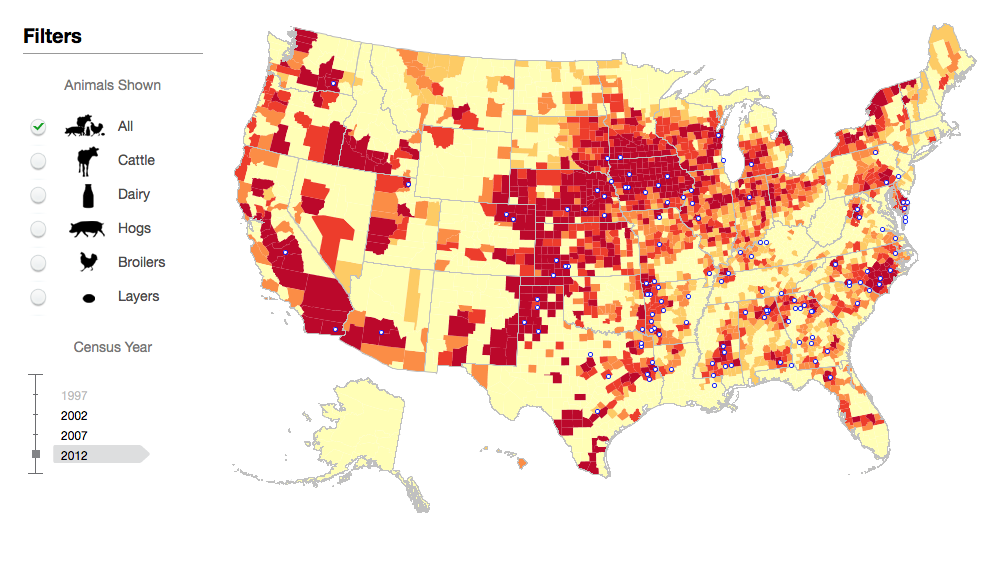
Explore our Factory Farm Map to discover the true extent of factory farms and egg-laying hen facilities across the U.S., and understand their impact on animals, communities, and the environment.
Have you ever wondered, “Where are factory farms located?” or searched for “factory farms near me”? The interactive Factory Farm Maps from Food & Water Watch's Factory Farm Nation campaign offers eye-opening insights.
This comprehensive livestock farming map vividly illustrates what rural communities have experienced for decades:
“We wanted to illustrate something that people in rural America have known for a long time: independent family farms are being replaced by factory farms, and these facilities are overwhelming some regions of the country. This method of raising livestock harms rural communities and puts small family farms out of business. It takes away consumers’ choice at the grocery store, makes food safety problems happen on a larger scale, and creates more waste than the surrounding environment can adequately absorb. It keeps animals packed tightly together inside buildings and relies on overusing antibiotics, creating a perfect breeding ground for antibiotic-resistant superbugs that can make all of us sick.”
Why Factory Farming Matters
Egg-Truth firmly believes that no form of farming is acceptable when it involves exploiting animals. However, factory farms clearly represent the most severe conditions animals endure. According to the Factory Farm Nation Project:
“Factory farms also are detrimental to the animals themselves. Most factory-farmed hogs and chickens have no access to the outdoors and never see daylight. Beef cattle and dairy cows spend time outside, but they are confined to feedlots with no access to pasture or grass, which is what they are built to eat. The lack of outdoor access, inability to express natural behaviors, health problems and stress caused by production practices, and breeding designed to maximize weight gain or egg and milk production take a toll on animal welfare.”
At Egg-Truth, we recognize that these maps don't just depict locations—they reveal a powerful truth: Choosing plants over animal products isn’t simply a personal dietary preference. It profoundly impacts animal lives, human health, and environmental sustainability.
Using the Factory Farm Map
Curious about the scale of egg production and factory farms near you? Navigate the Factory Farm Map by state and county to discover detailed data on local egg-laying hen operations and other livestock industries.
Livestock Farming Map: Beyond the Hen
While our focus at Egg-Truth is predominantly on hens, this map also covers other types of livestock. Dairy cows and beef cattle might have some access to the outdoors, but they are mostly confined to feedlots, severely restricting their natural behaviors. To understand more about factory farming's impact on cows on dairy farms, check out our sister website Dairy-Truth.
Explore More with Egg-Truth
Understanding the severity of factory farming is the first step. From here, you can dive deeper:
Learn about the reality hens in the egg industry face daily.
Explore the environmental consequences of egg production.
Find practical guidance for transitioning to plant-based alternatives.
Every decision counts. When we leave eggs off our plates, we take meaningful action against animal cruelty, environmental damage, and health risks posed by factory farming.
Together, let's choose compassion. Please leave eggs off your plate.
What Happened in Winnipeg Should Be A Wake Up Call!
On April 1, 2021, workers at the Brady Municipal Landfill site in Winnipeg, Manitoba, Canada, discovered a very disturbing scene . . .
Thousands upon thousands of dead, egg laying hens litter the Brady Landfill, Winnipeg, MB, Canada. Note the dead pigs in the background. It is unclear where they came from and garnered no mention in media reports.
On April 1, 2021, workers at the Brady Municipal Landfill site in Winnipeg, Manitoba, Canada, discovered a very disturbing scene: tens of thousands of dead, egg-laying hens. Treated like trash, their broken and fragile bodies had been dumped at the site by an area egg farm. However, there appeared to be movement among the mass of contorted bodies - some of the hens were still alive! Shocked, the workers called a local farm sanctuary to inform them of what they saw and in hopes of having these few remaining souls rescued. Sadly, this was not the first time this had happened.
Ethics
News of this atrocity got out and was first reported by CTV News Winnipeg. Interestingly, the focus of the news report was not necessarily about the thousands of dead hens rotting in the open air, it was about the few who survived and were found writhing amongst the carnage. Make no mistake, the fact that still-alive hens were left to die a slow, painful death is a horror unto itself, but no less were the thousands of innocent ‘spent-hens’ who were killed and dumped like garbage simply because they were no longer profitable.
Above is a photo gallery of images taken from the Brady Landfill, April 1, 2021. Photo credit: The Good Place Farm Sanctuary.
A spokesperson from the Winnipeg Humane Society interviewed by CTV News was quoted as saying that these birds, “were among thousands of euthanized hens that were dumped at the landfill”. Euthanized? The definition of euthanasia is as follows: it is the practice of intentionally ending life to relieve pain and suffering. These hens were not euthanized, they were killed (gassed) to ensure profitability for the egg farm. Commercial hens have been genetically manipulated to lay an excessive number of eggs in their abbreviated life span of approximately 18 months. Once they reach the end of their laying cycle, their exhausted bodies can no longer lay the quantity or quality of eggs for the farmer to keep housing and feeding them, and must make way for younger pullets who have reached egg laying maturity. Thus, egg farms will “de-flock” their barns and kill the spent-hens (an industry term) either through on-site killing or sending them to slaughter. The natural life expectancy of a rescued commercial hen can be anywhere from 4-8 years, as can be testified to by many farmed animal sanctuaries, or longer if their bodies do not succumb to the common illnesses afflicting commercial hens such as ovarian cancer, osteoporosis, egg-yolk peritonitis or other diseases. In nature, their wild cousins can live 10-12 years.
A photo of “Penny”, a spent-hen rescued from the manure pits at an egg farm in British Columbia, Canada. Photo credit: Geoff Regier
How Did This Happen?
We interviewed Jen from The Good Place Farm Sanctuary (GPFS) to learn details of what happened.
A dump truck carrying thousands, perhaps tens-of-thousands, of “spent hens” arrived from an area egg farm. They were dumped at this municipal landfill to ultimately be moved into a pit. Workers, as on previous occasions, saw movement among the dead pile. Six hens on top were still alive. Jen and one of her volunteers arrived at the scene. One of the hens died on site and they managed to rescue five others. They searched the pile hoping to find others. But given the pile was many feet high over a vast area, there were no doubt alive birds near or at the bottom that could not be saved.
Jen and her volunteer were haunted by the possibility that they might miss one. After a period of time, the five they rescued were driven to a local vet. One of the hens, in particular, was in bad shape - they named her “Pearl”. She didn’t make it. The remaining four did and most ended up at several other sanctuaries (see footnote below).
Jen managed to reach out to the provincial vet responsible for farmed animals in Manitoba. Jen learned that a company was contracted by farms throughout the province who would conduct the mass killing of these birds using a mobile CO2 gas chamber. According to sources, this issue of still-alive hens being dumped at landfills had happened multiple times dating back to at least 2020. There was an investigation that year over a similar incident and recommendations were made to improve methods to ensure no hen came out of the chambers alive. Clearly, the issue was never resolved. Sources informed Jen at GPFS that the same thing happened approximately four days later after this particular incident. Landfill workers have said they often dread the days hens come to the facility because they would routinely see the same thing, over and over and over again. (Note: it is our understanding that municipal workers at this landfill have been reprimanded and instructed not to speak to anyone in the future on matters such as this.)
One of the rescued hens. Source: The Good Place: Farm Rescue & Sanctuary
Jen also observed that the pile of discarded hens at the Brady Landfill were likely not caged birds, but free-range or free-run. Jen noted that these hens did not have curled feet which comes from living on a wire floor in a cage for up to a year-and-a-half, as most hens do in Canada. The few they rescued didn’t seem skittish or afraid of her and her volunteer and seemed adept to walking on the ground. Caged hens are unfamiliar and unaccustomed to walking on the ground or interacting with people.
Another one of the rescued hens. Source: The Good Place Farm Rescue & Sanctuary
The “Manitoba Egg Farmers said it was "devastated" to hear about the five hens found alive”. “Devastated”? Why because the farm and/or the hired company failed to kill the few who survived which made its way to news reports? The Manitoba Egg Farmers, and Canada’s egg industry in general, kills millions upon millions of spent hens every year in addition to an equal number of male chicks who are useless to the egg industry as they don’t lay eggs. The egg industry IS a slaughter industry no different than meat or dairy production.
And herein lies the issue as it relates to the exploitation of egg laying hens: some of us (certainly not the egg industry) are not necessarily shocked or saddened to learn of thousands being killed in a story like this, we are saddened to learn that some were still alive. Think about this for a moment: is our empathy reserved largely for the suffering of those still alive, while ignoring the suffering of all those who were once confined and condemned to lay only to be killed and discarded like trash? Are not all the dead hens in this story entitled to the same moral concern as the ones found alive? Should we not be outraged and sickened by the massive dead pile? Absolutely!
Manure pits beneath the stacks of battery cages on an egg farm in British Columbia, Canada. Photo credit: Geoff Regier
Disease
A live market in New York City. Click on photo to enlarge.
In the sober new reality of global pandemics, our world needs to take a very hard look at the risk factors of animal agriculture and, in this case, the egg industry. Avian and swine flu, antibiotic resistance, zoonotic diseases such as SARS, MERS, AIDS, Ebola, and now Covid-19 are either caused directly, or indirectly, by intensive animal agriculture, stress imposed on natural ecosystems as a result of human encroachment, the harvesting of wildlife (ie. bush meat), and wet markets.
Yet despite all that we have learned, we still see scenes like the Brady Landfill playing out - thousands upon thousands of corpses from factory farms, rotting in the sun and out in the open? One thing most of us surely know from having been to a landfill or waste facility, there is a lot of wildlife that are attracted to these places: sea gulls, mice, rats, turkey vultures, raccoons, cats, dogs, and those predators preying on those scavenging the garbage. It is absolutely shocking that in a first world country like Canada, in the 21st century, dead farm animals would be dumped at a municipal landfill with the corpses of these animals free to come into contact with wildlife. And let’s not forget the municipal workers who are working at these facilities - what about the risk of exposure to them? All it takes is one pathogen to jump from animal to human. It has happened before and will, in all probability, happen again.
Propaganda
“We take accusations about animal cruelty very seriously”. How many times have you heard a PR person for an industry group say this every time a story emerges like this landfill story? Are they to be believed?
A screen shot from Manitoba Egg Farmers website depicts, ‘smiling, laughing’ people joyfully engaged in the business of egg production. A business that imposes untold misery and deprivation for the millions upon millions of hens exploited across Canada annually.
This is a standard reply designed to assuage public concern about animal welfare. The egg industry in Canada, and elsewhere, devote considerable sums of money to present an image of a clean, green and caring industry. They focus a lot of their efforts to remind consumers that they are feeding “you and your family” - sounds wholesome doesn’t it? Often they’ll recruit from their 1,200 members across Canada to profile a few of those who run and operate egg farms and portray them as ‘smiling, hard-working Canadians’ . . . . just like you! And if they are just like you they can’t be all bad, right? The focus of these carefully, crafted advertising campaigns are always on the family-run farms and invoke words like “community”, “care” and promote the healthful and nutritious aspects of eggs. Never do they focus on the hens and rarely show you inside an egg barn containing thousands of birds. And if they do, it is always of a barn that has been “de-flocked”, cleaned and re-populated with pullets who have just reached egg laying maturity and look clean, healthy and vibrant. Never will you see images or video of a barn 12-18 months afterwards. Why? Because it is not a pretty sight.
Generally speaking, the egg industry routinely anthropomorphizes animals when it comes to their consumer packaging and advertising campaigns by using cartoon depictions exhibiting human like qualities and facial expressions. This is true for Canada as it is for many countries around the world like the United States, United Kingdom, the European Union, etc. This is done in an effort to depict the industry as benign or harmless. Words like “Happy”, “Farm Fresh”, “Organic”, “Local” are ubiquitous.
The fact is, egg farming is a slaughter industry - it is violent and bloody. Male chicks are shredded alive shortly after hatching, females are often de-beaked, vaccinated against high risk diseases as a result of high stocking densities, endure many illnesses along the way, and then slaughtered after 18 months. Sometimes they are killed on site, dumped in a pit and buried, or incinerated.
Canada’s egg industry does not want you to know any of this because they know the average Canadian would be appalled at this kind of animal cruelty. Nonetheless, it is how commercial hatcheries, egg farmers, and the industry as a whole, can maximize profitability. And let’s be clear, all egg farming associations, whether provincial or federal, exist to promote the financial sustainability and profitability of their members first and foremost. And, part of that mandate, requires them to market and promote what they do in the most sanitized and favourable light possible.
The photo gallery below shows what the Egg Farmers of Canada publishes on their website and accompanying photos of the reality on Canadian egg farms:
Conclusion
Don’t trust anything the egg industry says. At least, view what they say with deep suspicion. It is in their interest to keep information like this out of view from Canadians. Even now, animal agriculture has succeeded in enacting legislation like Bill 156 in Ontario. And now Manitoba is considering the same thing - and you can be assured that the Manitoba Egg Farmers are in favour. Bill 156 in Ontario was lobbied for very hard by the animal agriculture sector. They’ll tell you it is about “protecting the food supply”, and ensuring that “food biosecurity” is a priority or by “protecting the property rights of farmers”. While this sounds reasonable, it is really about eliminating these kinds of videos and stories getting out. Why? Because it hurts business. And as the Premier of Ontario has often said, “Ontario is open for business”. It appears this is certainly true - but in the end, it is the animals who will pay the price.
But there is an alternative to all of this. There are so many cruelty-free, delicious and affordable egg-free alternatives available. And the great news is these alternatives are readily available in most grocery stores and health food stores across Canada! So please consider leaving eggs off your plate. Compassion is never the wrong thing.
And please consider contacting your area MP or MPP to tell them that you oppose any type of ag-gag legislation:
Search for your Canadian Member of Parliament.
Search for you Member of Provincial Parliament:
British Columbia
Alberta
Saskatchewan
Manitoba
Ontario
Quebec
New Brunswick
Nova Scotia
Prince Edward Island
Newfoundland & Labrador
Support Farm Sanctuaries Not Animal Farmers
If you would like to support the rescue of egg laying hens, please consider becoming a volunteer, or offering financial support to The Good Place Farm Sanctuary. And if you want to help one of the organizations who rescued the hens from the Brady Landfill, consider a donation to:
Rainbow Ranger Station (who rescued “Piper”)
Ledwich Family Farm (who took in “Karen”)
The Little Red Barn Sanctuary (who took in “Star”).
Or, consider supporting any number of farm sanctuaries around the world. Our “Resources” page has a very comprehensive list of sanctuaries, large and small, across the globe.
Footnote:
Dead pigs are visible in the background. Click on photo to enlarge.
We reached out to the Canadian Pork Council asking for comment on the dead pigs visible in the background of the photo of the pile of dead hens. A excerpt from their response is below.
To highlight, the CPC says, “mortalities are an unfortunate part of food production”. Unfortunate because they couldn’t profit from the ones that died? All animals face “mortality” in the food system. Mr. Ross the ED of the Canadian Pork Council goes on to say that the $83/tonne fee to dump dead pigs is the same as commercial garbage. We have reduced living beings to “commercial garbage” like tin cans, plastic containers, paper, and discarded cardboard.
““ . . . mortalities are an unfortunate part of food production . . . The disposal of mortalities is regulated by the Province of Manitoba. One approved option is to utilize the Brady Landfill . . . animal disposal arrangements must be made in advance and are subjected to an $83/tonne fee. This is the same fee applied to commercial garbage disposal.””
Nigel Osborne is the Executive Dir. of Egg-Truth. Nigel has years of experience related to animal rights and on-line advocacy. Nigel's extensive background in the publishing, outdoor advertising, printing and web design industries over the last 25 years provides him with a strong, creative acumen and business management experience. Through Egg-Truth.com and it's social media channels, Nigel seeks to increase awareness among the public about global egg production, expose the conditions for the billions of hens condemned to laying every year, and reveal the true impact of egg consumption on human health.
Gerri's Story
“Saving Gerri was, hands down, the most humbling and inspiring thing I’ve ever done in my life”. - Georgia Rae Laidlaw Brown
Gerri on her day of rescue.
Saving Gerri was, hands down, the most humbling and inspiring thing I’ve ever done in my life.
And even as a long-term vegetarian (now vegan activist), I had no idea how intelligent and kind natured chickens could be.
The day we rescued Gerri was the day she was destined for the slaughterhouse. Her days as a commercial laying hen were over and the next step in the process was for her “to be finished” - an industry term that means: killed and sold to the public as meat!
Luckily for Gerri, and the other 200+ chickens with her that day, they were given a second chance and were re-homed.
Gerri’s life was brutal from the very beginning, and even years later I have trouble processing what had intentionally been done to her. The photo shown here is of Gerri on the day she was rescued. Until this time, she had never seen daylight, her wings and beak had been clipped and she had been laying eggs at the unnatural rate of approx. 340 eggs a year in caged isolation. This is a sad fact-of-life for chickens that is a well-kept secret from consumers.
Much of the language used to describe how animals are treated in factory farms is chosen to mislead the public and paint a picture that makes the whole process acceptable. Make no mistake, the words and images are carefully chosen. Words like, “welfare” are used to mask what is actually just varying degrees of deprivation and cruelty. The images of happy, healthy chickens we often see on egg boxes are a misrepresentation of the conditions in which chickens live. And this include eggs sold as “free-range” and “organic” which may be the most misleading of all.
But lately attitudes have been shifting. Thanks to many main-stream documentaries and under-cover videos on social media and elsewhere, more and more people are beginning to see what is going on. Every day the conditions that all animals endure on factory farms is being exposed and talked about and the truth is getting harder to hide.
Gerri gettin’ in to the cream cheeze!
So… a little more about Gerri. She is as hilarious as she is bold and brave. From her very first day with us, she has taken everything in stride. (Here she is, covered in vegan cream cheese after sharing a bagel with me!) Just look at her little face!
When we first rescued Gerri she was not going to be a house chicken. She is one today because that is what she wanted. Daily she would peck at our door asking to come inside and before we knew it, she was spending most of her day in the house with us. She does venture outside to sleep in her house, or at the bottom of the garden, and for the occasional stroll around the property.
Like many animals who are given the chance to live in a loving and nurturing environment, Gerri knows her name and she will come running to you when called. She also likes to hang out with her cat and dog siblings and enjoys napping in the dog bed.
Gerri and her canine siblings.
Also, like everyone, Gerri is an individual with personal likes and dislikes and that extends to her food preferences. Her favourite food is mashed potato, but her preferences can change depending on her mood. Of course, she has her organic corn and pellets, but she is also partial to hummus, tomatoes, blueberries, cashew nuts, jackfruit, but not yellow peppers… she can’t stand them and will spit them out!
Gerri is my daughter, and my best friend, and I really do love her very much! She is a huge part of our family and loved completely and equally alongside the other animals (and humans!) She’s very expressive, funny and will fuss around you for attention just like the dogs do.
Gerri scoping out her sleeping arrangements.
In fact, I haven’t met anyone that hasn’t been blown away with how clever and sweet natured Gerri is – and I truly believe that all chickens have this potential, if they are only given the chance.
Gerri inspires me every day and I’m honoured to share a little more about her life and her story as well as shedding a little light on the commercial egg industry that exploits these beautiful animals.
I would encourage everyone to consider giving up eggs and going vegan. And, if your situation is right for it, rescuing an ex-commercial laying hen. You can also make a difference by donating to the various chicken rescue organisations. As individuals we can each a make huge difference.
As for Gerri, her confidence and character grows daily and I hope that her story inspires people to see what wonderful friends and family members chickens can be!
For more images and videos etc. head to: Georgia Rae Laidlaw Brown.
To learn about the true lives of the billions of hens condemned to lay in commercial, egg farms around the globe, please visit: Egg-Truth
Georgia Rae Laidlaw Brown has been vegan for 3 years and is a trained Broadcast Journalist and PR Professional. She is vegan for the animals, but also for the environment, her health and future generations.
Sarah's Story
It's perhaps surprising that many people don't consider this question very often - perhaps because the suffering that exists in the egg industry is so hidden from us . . .
Sarah. Photo courtesy of: Little Oak Sanctuary
Hatching date: 1 November 2015 | Arrival date: May 2017
It's perhaps surprising that many people don't consider this question very often - perhaps because the suffering that exists in the egg industry is so hidden from us, and our direct experience with chickens and eggs, if we have any, is a far cry from what most chickens experience in the commercial egg industry.
Sarah is a hen who came to Little Oak Sanctuary in 2017. Her experience gives us a glimpse into what the 16 million hens experience each year in Australia in order to produce eggs for people. May is International Respect for Chickens month, the perfect time to share her story with you.
Born into the Australian Egg Industry, Sarah never knew her mother. Rather than entering the world under her mother's protective wings, Sarah hatched from her egg onto a wire tray, among thousands of other chicks.
Soon after hatching, Sarah and her sisters were sorted from their brothers, and any of their sisters who were sick or weak. As male chicks are not able to produce eggs, and are not suitable for meat production (the chickens bred for meat are an entirely different bird), they are considered waste products by the egg industry and killed by maceration or gassed the day they hatch, along with weak or sick female chicks.
Sarah and her sisters were then taken and placed beak first into a machine that cut their tiny beaks with a hot blade. This process is called "de-beaking", a practice aimed to reduce pecking between hens who are kept in situations where they cannot form natural hierarchies or move away from each other.
“
“Anything that is held in secret cannot be healed. The light cannot reach that which is locked away in the dark.””
Once Sarah was old enough to start laying eggs, she was taken to a battery egg farm, like 9 million other hens each year in Australia. Many people don't realise that the majority of eggs produced by hens in battery cages are sold for use in cafes, restaurants and products that contain egg. Sarah then spent the next 12 months of her life in a small cage with 7 other hens. Denied everything a hen values, the ability to form a natural pecking order, nesting space, room to dust bathe and spread your wings, the chance to live your life.
Modern layer hens have been selectively bred so that they produce around 300,000 eggs per year at their peak level of production. Prior to human intervention, hens would naturally lay up to 15 eggs, once a year in spring - as a single clutch (like other birds!). This unnatural level of production we have thrust upon 'egg laying' hens taxes their little bodies tremendously and they are not able to maintain it for long - usually only around a year - before the level of laying reduces.
At this point they are considered 'spent' and are no longer commercially viable. In a process referred to as "depopulation" they will be taken from their cages, moved into small transport crates with around 5 other hens, and taken to slaughter, typically for pet food. Egg laying hens are not used for chicken meat, having been bred specifically to produce a huge number of eggs, rather than to grow large breast muscle.
Fortunately for Sarah, she and 29 of her sisters were spared from slaughter at this point, and found sanctuary at Little Oak. Sarah now spends her days advocating for her kind, enjoying the sunshine and wind through her feathers, dust bathing in the soil and perching on a roost - according to her flocks pecking order - at night.
You can spare the 16,000,000 hens like Sarah a lifetime of suffering - and her brothers who don't get to live past a day - by leaving eggs and egg products off your plate.
This article was re-published with the expressed permission of Little Oak Sanctuary.
Kate & James are the co-founders and operators of Little Oak Sanctuary in Australia. Kate works outside of her sanctuary to fund its operation. Kate is a professional photographer and business manager for a not-for-profit organisation in town whilst James is a musician who teaches and plays professionally. All positions at the sanctuary are unpaid and donations received go towards the animals and advocating for them.